I used to think acne was acne.
A pimple on the forehead?
Acne.
A blackhead on the nose?
Acne.
A painful lump under the skin along the jaw?
Also acne.
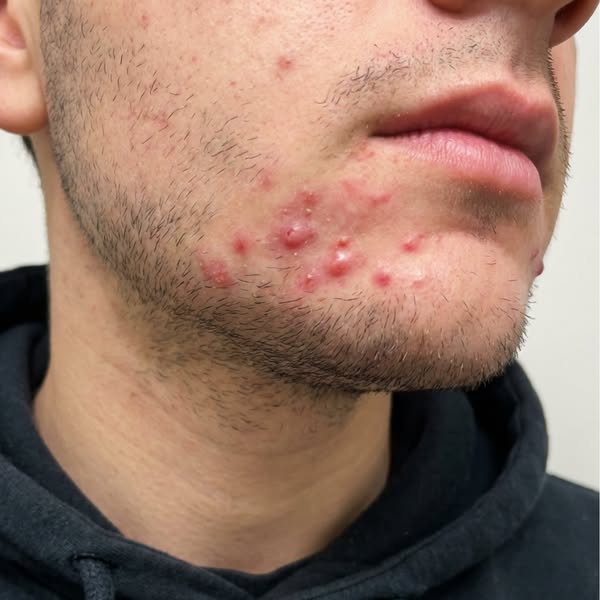
So when my teenage son’s face suddenly seemed to become a map of completely different breakouts, I did what I think most parents do.
I went to the drugstore.
And bought something that said “acne” on the bottle.
Then another one.
Then another.
For months, our bathroom counter looked like a small skincare aisle.
And somehow his face kept getting worse.
That was when I finally realized something I wish I’d understood much earlier:
Not every spot on his face was behaving the same way.
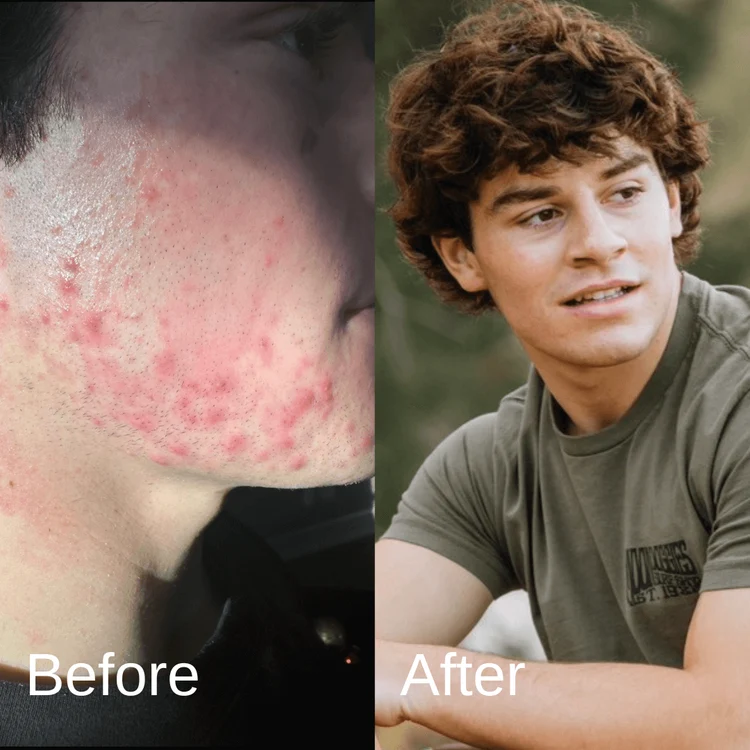
It Started Across His Forehead
The forehead was the first place I noticed it.
Tiny bumps.
Some blackheads.
Little whiteheads that seemed to appear almost overnight.
Nothing looked especially severe at first.
But under bathroom lighting, I could see that his skin was becoming more congested every week.
So we bought an acne cleanser.
Then a scrub.
Then another cleanser that promised to “deep clean pores.”
For a few days his face would look drier.
And we would think:
Finally. It’s working.
Then the bumps came back.
Usually with redness around them.
Looking back, I think we confused dryness with progress more times than I want to admit.
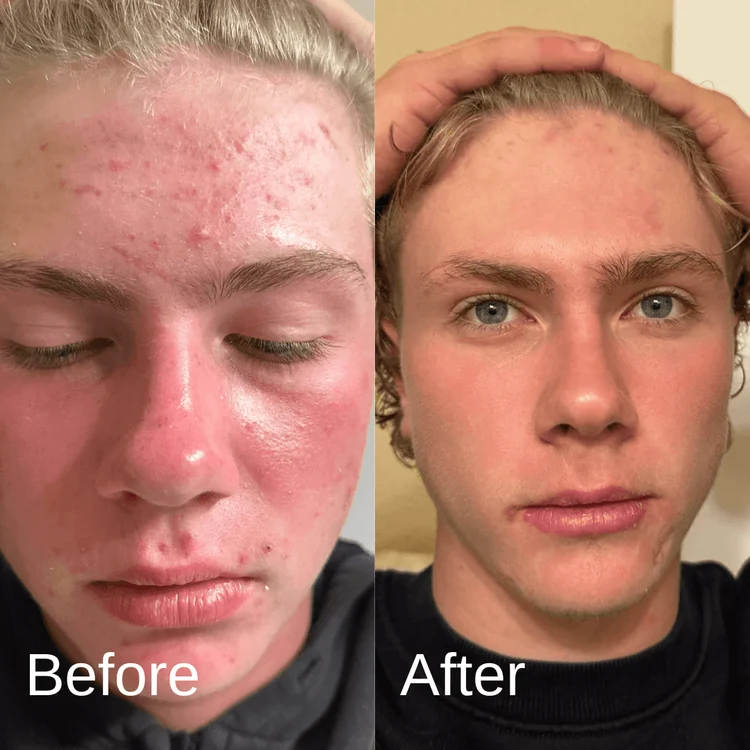
Then His Cheeks Changed
The forehead acne was annoying.
His cheeks were different.
Those spots became redder and angrier.
Some hurt when he touched them.
There were mornings when he’d walk downstairs and I could immediately see that another inflamed pimple had appeared overnight.
And I began noticing something else.
He didn’t want me talking about it.
I’d say:
“Your skin looks a little better today.”
He’d immediately change the subject.
Or I’d suggest trying another product and get the teenage response every parent knows:
“Mom, please.”
That was when I understood this wasn’t just something happening to his skin.
It was starting to affect how he felt about himself.
The Jawline Was What Finally Worried Me
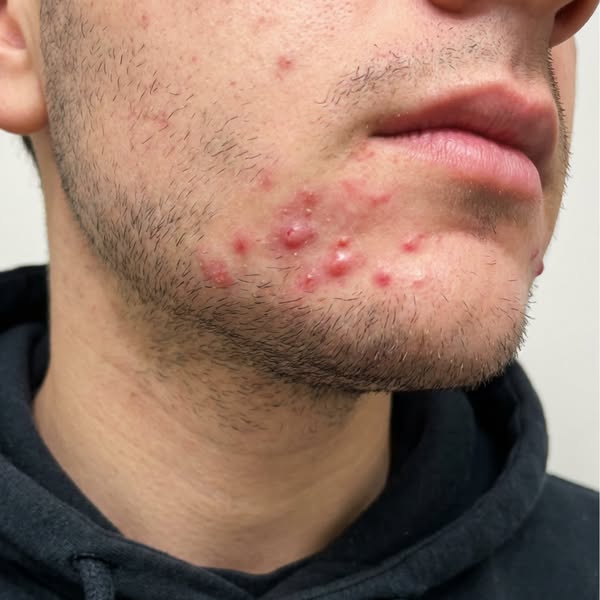
Then he started getting those deep spots.
Not little whiteheads.
Not something that would disappear in two days.
These were painful bumps underneath the skin, especially around the lower cheeks, chin and jaw.
Sometimes there wasn’t even much to see at first.
But he’d tell me:
“There’s another one coming.”
He could feel it before I could see it.
And once it appeared, it could hang around for what felt like forever.
That’s when I started researching acne seriously instead of buying whatever bottle had the most convincing label.
And the first thing I learned was that acne isn’t one single process.
Acne Is Happening Inside the Follicle
Acne develops in what dermatologists call the pilosebaceous unit—basically the hair follicle and its oil-producing gland.
During puberty, hormones can increase oil production.
Dead skin cells can accumulate and clog follicles.
Cutibacterium acnes bacteria can contribute to inflammation.
And the immune response around that clogged follicle can turn a barely visible blockage into a red, painful breakout.
That’s why teenagers can have several types of acne at the same time.
Blackheads.
Whiteheads.
Red inflammatory pimples.
Pustules.
And sometimes deeper nodules or cyst-like lesions.
Acne is incredibly common in adolescents, and medical reviews estimate it affects roughly 85% of teenagers.
Suddenly my son’s face made more sense.
But it also made me realize we’d been doing something wrong.
We Were Trying to “Dry Out” Everything
Most of the products we’d bought had one goal:
Strip away oil.
Make the skin feel squeaky clean.
Dry the pimples as aggressively as possible.
And my son hated using them.
His face would feel tight.
Sometimes it peeled around his mouth.
Other products made his skin sting.
So he’d use something for four or five days, get irritated and quietly stop.
Then I’d ask:
“Are you still using the wash?”
And he’d say:
“Sometimes.”
Which meant no.
That cycle went on far longer than it should have.
Then I Learned More About Benzoyl Peroxide
I’d seen the words benzoyl peroxide on acne products for years.
I assumed it was just another harsh chemical that dried pimples out.
It isn’t.
Benzoyl peroxide is actually one of the most established acne treatments available.
The American Academy of Dermatology strongly recommends topical benzoyl peroxide because it reduces acne-causing bacteria, and it’s commonly used alone or alongside other acne treatments.
So the problem wasn’t that benzoyl peroxide “doesn’t work.”
It does.
The problem for us was finding something my son would actually use consistently without feeling like his face was being punished every night.
Because benzoyl peroxide can cause dryness, redness, peeling and irritation, especially depending on the concentration and formulation.
And an acne treatment sitting unused in the bathroom isn’t much of a treatment.
That’s When I Came Across Shield
I found Shield while reading about acne products designed specifically with teenage and men’s oilier skin in mind.
Normally, phrases like “new acne technology” make me suspicious.
So I started reading the ingredient list before I read the reviews.
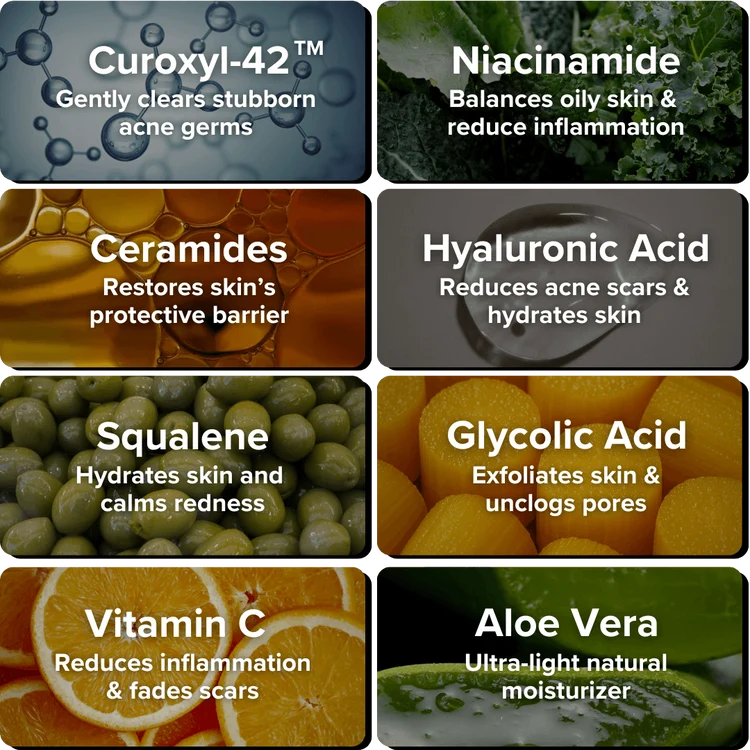
The Shield Face Wash uses 4% benzoyl peroxide in a formulation the company calls Curoxyl-42.
Shield describes Curoxyl-42 as a micronized benzoyl peroxide technology designed to deliver the active ingredient effectively while producing less irritation than conventional formulations.
That caught my attention.
Not because benzoyl peroxide was new.
It wasn’t.
But because I finally understood that formulation matters almost as much as the ingredient name on the front of the bottle.
The Part That Made Me Keep Reading
Shield says a six-week double-blind study of Curoxyl-42 found that 97% of participants had less acne, while the formulation produced 37% less irritation than traditional benzoyl peroxide.
Those figures are the company’s reported study results, not something I would treat as a guarantee for every teenager.
But after watching my son abandon product after product because his face felt dry and irritated, the second number interested me almost as much as the first.
Because I didn’t need the strongest product in the bathroom.
I needed one he would actually keep using.
And It Wasn’t Just Benzoyl Peroxide
When I looked at the rest of the face wash, I noticed something our previous acne routine had mostly ignored.
The skin barrier.
Shield combines its benzoyl peroxide with ingredients including niacinamide, ceramides, glycerin and sodium hyaluronate, along with glycolic acid.
Niacinamide is commonly used in skincare for its soothing and barrier-supporting properties.
Ceramides help support the skin’s protective barrier and moisture retention.
Hyaluronic acid is primarily a hydrator.
And that last point matters because I had seen an ad claim hyaluronic acid could “prevent acne from ever coming back.”
That’s not something I’d tell another parent.
Hyaluronic acid can help hydrate the skin.
It is not a permanent acne-prevention switch.
So We Changed the Goal
For months, our goal had been:
Destroy the acne.
Now it became:
Treat the acne without destroying his skin in the process.
That may sound like a small difference.
For my son, it changed everything about the routine.
No complicated seven-step skincare schedule.
No different bottle for every square inch of his face.
No scrubbing until his cheeks turned red.
Just consistency.
And patience.
Which, as every parent of a teenager knows, is easier said than done.
The First Week Wasn’t Dramatic
This is where skincare ads usually jump from “before” to “after.”
Real life was much less exciting.
After a few days, he still had acne.
Of course he did.
Acne treatments don’t erase clogged follicles overnight.
But the first encouraging sign was that he wasn’t complaining about his face feeling destroyed after washing.
So he kept using it.
That mattered.
At the end of the first couple of weeks, the first thing I noticed wasn’t that every pimple had disappeared.
It was that fewer new angry-looking ones seemed to be joining the old ones.
I kept that observation to myself.
The last thing a teenage boy wants is his mother conducting a daily dermatological inspection over breakfast.
Then One Morning He Said Something
We were driving somewhere when he looked at himself in the passenger-side mirror.
He stared for a few seconds.
Then said:
“My forehead is actually getting better.”
That was it.
Six words.
But I knew what they meant.
He had noticed it himself.
Not me pointing it out.
Not some before-and-after marketing picture.
Him.
And once he saw progress, getting him to stick to the routine became much easier.
His Forehead Changed First
The tiny bumps and clogged-looking texture were becoming less noticeable.
Then the cheeks started looking calmer.
The deeper spots were the slowest.
That didn’t surprise me once I’d learned more about acne.
Deep nodules and cyst-like acne aren’t the same as a few blackheads.
The American Academy of Dermatology specifically recommends seeing a dermatologist for deep nodules or cysts because these lesions can scar and often need stronger treatment.
That’s one thing I would tell every parent:
Don’t spend six months experimenting with face washes if your child has severe, painful or scarring acne.
A cleanser has limits.
Sometimes a dermatologist is exactly what your teenager needs.
That’s Also Why I Don’t Believe One Wash “Clears Every Acne Type”
That line sounds great in an advertisement.
It’s not how acne medicine works.
Benzoyl peroxide is particularly useful for inflammatory acne and is a major first-line treatment.
But acne can also require topical retinoids, other prescription treatments, oral medications or isotretinoin depending on severity and the type of lesions involved.
So Shield wasn’t some magical replacement for dermatology.
It became a much better first-line daily routine for my son than the random products we’d been cycling through.
That’s an important difference.
The Biggest Change Wasn’t Actually His Skin
A few weeks into the routine, I noticed he wasn’t standing two inches from the bathroom mirror anymore.
He stopped asking if a pimple looked “really bad.”
He didn’t pull his hood forward as often.
And one morning, he walked downstairs ready for school without trying to hide the side of his face.
Nobody put that on the ingredient list.
But as his mom, that’s the result I noticed most.
Teen acne gets dismissed as something everybody goes through.
And yes, it’s incredibly common.
But that doesn’t mean it can’t hurt.
Teenagers are taking pictures constantly.
They’re on video calls.
They’re seeing their own faces on screens all day.
A painful breakout isn’t just a medical diagram to them.
It’s the face they’re taking to school tomorrow morning.
What I Wish I’d Known From the Beginning
I wish I’d stopped searching for the product that could make his face bone-dry overnight.
I wish I’d understood earlier that irritation isn’t proof something is working.
I wish I’d understood that benzoyl peroxide wasn’t the enemy just because some formulas had irritated him.
And most of all, I wish I’d known that consistency beats having five half-used acne products sitting in the shower.
Shield currently uses 4% benzoyl peroxide alongside barrier-supporting and hydrating ingredients, and the company offers a 100-day money-back trial.
That’s ultimately why I felt comfortable giving it a chance.
Not because I expected perfection in seven days.
Because we had enough time to see what happened.
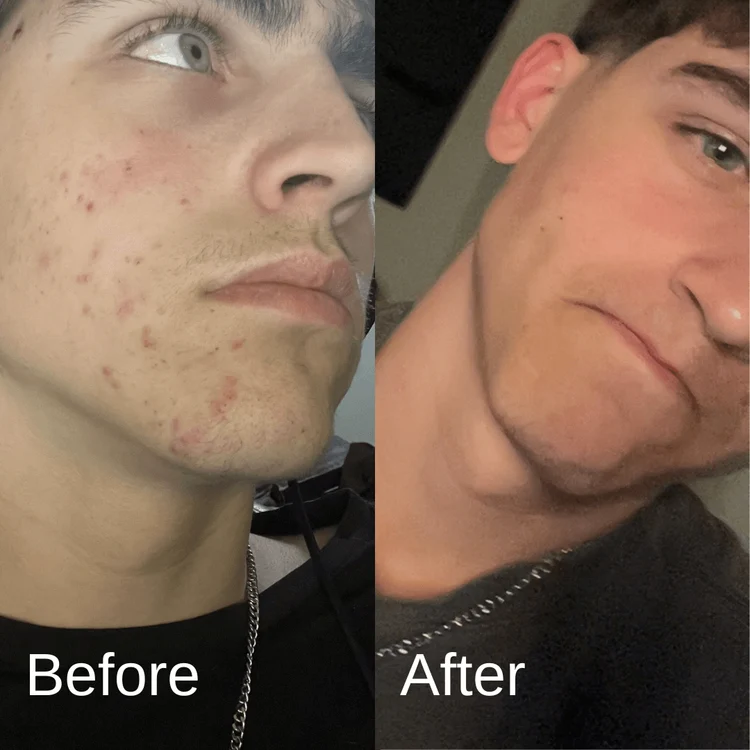
If Your Teenage Son’s Face Looks Like an “Acne Map,” Start Here
Look at what kind of breakouts he actually has.
Tiny clogged bumps?
Blackheads and whiteheads?
Red inflamed pimples?
Or deep, painful nodules?
If it’s mild to moderate acne, benzoyl peroxide is one of the evidence-backed ingredients worth considering.
If his skin becomes irritated, don’t assume burning means it’s “killing the acne.”
And if he has deep, painful acne, scarring or acne that isn’t improving despite consistent treatment, get a dermatologist involved.
I spent too long treating my son’s face like every breakout needed more force.
What he actually needed was a routine effective enough to fight acne and tolerable enough that he’d keep doing it.
For us, that distinction changed everything.
And if you’re standing in the skincare aisle looking at twenty bottles while your teenage son waits impatiently beside you, I understand exactly how overwhelming it feels.
I was there.
I just wish somebody had told me sooner:
The best acne treatment isn’t necessarily the one that feels strongest.
It’s the one that treats the acne and your teenager can actually stick with long enough to see a difference.
This article is an illustrative first-person advertorial for general information. Acne severity varies, and deep, painful, scarring or persistent acne should be evaluated by a qualified dermatologist.