If you have an older dog, chances are you’ve had that moment.
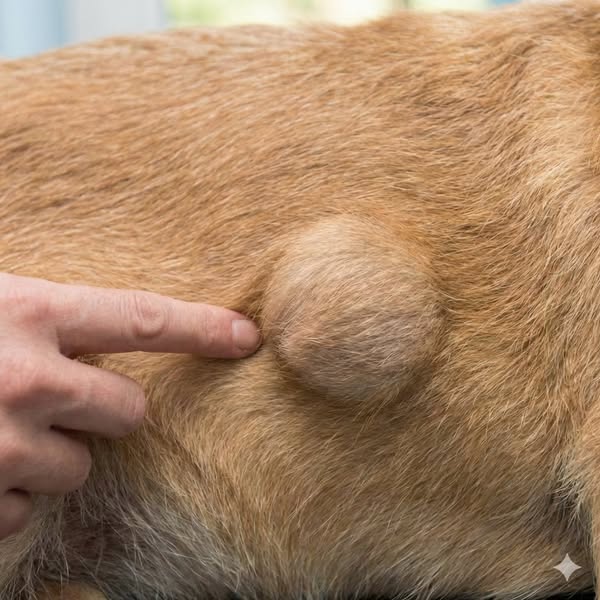
You’re scratching their belly, rubbing their chest, or running your hand along their side when suddenly you feel something that wasn’t there before.
A lump.
For many dog parents, the first reaction is instant panic.
But in older dogs, some of these soft, movable lumps turn out to be lipomas — common benign tumors made of fatty tissue. They often grow slowly and may never cause serious problems. Still, every new lump deserves attention because not everything that feels like a lipoma actually is one.
And lately, another name keeps appearing in conversations among senior-dog owners:
Turkey tail mushroom.
The colorful fungus — scientifically known as Trametes versicolor — has been used in traditional medicine for generations and is now appearing in a growing number of canine wellness supplements.
But why are dog owners paying so much attention to it?
And, more importantly, what does the science actually say?
Here are five things worth knowing before adding anything new to your dog’s routine.
1. Turkey Tail Isn’t Just Another Internet Wellness Trend
At first glance, turkey tail sounds like the kind of ingredient you’d expect to see in a social-media health craze.
But researchers really have studied compounds derived from this mushroom.
One of the most talked-about studies came from the University of Pennsylvania School of Veterinary Medicine.
Researchers studied 15 dogs diagnosed with hemangiosarcoma, an aggressive form of canine cancer, and gave them different doses of a standardized polysaccharopeptide, or PSP, derived from Coriolus versicolor, another scientific name historically used for turkey tail.
The early results attracted significant attention because some dogs in the small study survived longer than historical expectations.
That was enough to make turkey tail one of the most discussed medicinal mushrooms in the pet-wellness world.
But there’s an important detail that frequently disappears when the story gets shared online:
The study was about hemangiosarcoma — not ordinary fatty lipomas.
That’s a big distinction.
The research makes turkey tail interesting.
It does not prove that mushroom supplements make a dog’s lipomas disappear.
2. The Real Interest Is in Its Naturally Occurring Compounds
Turkey tail contains complex compounds including polysaccharides and beta-glucans.
These are among the reasons medicinal mushrooms have attracted research interest for their possible effects on immune function.
PetMD notes that turkey tail is rich in polysaccharides, particularly beta-glucans, and medicinal mushrooms continue to be studied for possible immune-supporting properties in dogs. Researchers are still learning exactly how useful these supplements may be over the long term.
That distinction matters.
Think of a supplement as support, not as a replacement for veterinary diagnosis or medical treatment.
If your senior dog suddenly develops a lump, becomes lethargic, stops eating, loses weight, or begins behaving differently, the first move shouldn’t be ordering a supplement.
It should be talking to your veterinarian.
3. That Soft Lump Still Needs to Be Checked
This may be the most important part of the entire conversation.
Dog parents sometimes become less worried about lumps after hearing that lipomas are common.
And yes — they are.
Cornell University’s College of Veterinary Medicine describes lipomas as one of the most common benign tumors seen in dogs. They are often soft, slow-growing and movable beneath the skin.
But here’s the catch:
You can’t reliably diagnose every lump just by touching it.
Other types of growths can sometimes resemble a lipoma.
Veterinarians may recommend a fine-needle aspirate, where a small sample of cells is collected and examined, to help determine what’s actually inside the mass.
So the smartest response to discovering a lump isn’t:
“It’s probably just fat.”
It’s:
“Let’s find out what it actually is.”
That one decision can make a huge difference.
4. Not Every Lipoma Needs Surgery
Here’s another misconception that worries many owners of aging dogs.
Finding a lipoma does not automatically mean surgery is coming next.
According to Cornell, many simple lipomas do not require treatment at all. Veterinarians may simply monitor them for changes.
Location matters.
Size matters.
Growth rate matters.
And most importantly, whether the lump affects your dog’s comfort or movement matters.
For example, a large lipoma near a leg or armpit can eventually interfere with normal motion, even though the growth itself is benign. In situations like that, a veterinarian may recommend removal.
But a small, confirmed lipoma that isn’t bothering the dog may simply be watched.
That is why individualized veterinary advice matters far more than blanket statements like “all lumps need surgery” or “all lumps can be treated naturally.”
Neither is true.
5. The Most Important Question Isn’t “Does Turkey Tail Work?”
It’s:
“What am I expecting it to do?”
If you’re expecting a powder to reliably erase an existing fatty tumor, the evidence isn’t there.
If you’re looking into turkey tail as part of a broader senior-dog wellness routine, that’s a different conversation — and one worth having with your veterinarian.
Research into medicinal mushrooms in veterinary medicine is ongoing, and even reviews of turkey tail-related studies caution that the available evidence is still limited. One veterinary evidence review examining turkey tail as an adjunct for canine lymphoma rated the strength of evidence as very weak and concluded that controlled research was still needed.
In other words:
Interesting? Yes.
Proven miracle cure? No.
And that may actually be the most useful thing dog owners can understand.
What Senior Dog Parents Should Do Instead of Chasing “Miracle” Claims
When our dogs get older, it’s natural to want to do everything possible for them.
We notice the slower walk.
The longer naps.
The gray around the muzzle.
The hesitation before jumping onto the couch they once launched themselves onto without thinking.
And when something new appears — especially a lump — we immediately start searching for answers.
But caring for a senior dog usually isn’t about finding one miracle ingredient.
It’s about stacking a lot of small, sensible decisions together:
Regular veterinary checkups.
Keeping your dog at a healthy weight.
Watching for changes in existing lumps.
Maintaining appropriate exercise.
Feeding a balanced diet.
Discussing supplements with your veterinarian.
And investigating new symptoms instead of assuming they’re simply part of aging.
One Final Warning About Mushrooms
Turkey tail supplements and random mushrooms growing in the yard are not the same thing.
Some wild mushrooms can be toxic to dogs, and accurately identifying mushrooms can be difficult.
PetMD recommends preventing dogs from eating wild mushrooms and contacting a veterinarian if your dog consumes one of unknown origin.
So don’t let the popularity of medicinal mushrooms turn into a reason to let your dog snack on fungi during a walk.
The Bottom Line
Turkey tail mushrooms have become a fascinating subject in canine wellness because there is genuine scientific interest behind them.
But the viral version of the story is often much simpler than the real one.
The famous University of Pennsylvania study involved dogs battling hemangiosarcoma, not dogs with ordinary fatty lipomas.
And while turkey tail continues to be studied for its potential role in immune support, there is currently no good reason to treat it as a guaranteed way to shrink fatty lumps.
For senior dog parents, the best approach is simple:
Check the lump. Know what you’re dealing with. Then make decisions based on your individual dog — not a viral promise.
And if you’ve ever found a mysterious lump on your dog, you’re definitely not alone.
Has your dog ever developed a lipoma? What did your veterinarian recommend? Share your experience — another dog parent reading it may be dealing with the exact same worry today.
This article is for general informational purposes and is not a substitute for veterinary diagnosis or treatment.