I had been getting migraines for eighteen years before I noticed the pattern hiding on my wrist.
And the strange thing is, I wasn’t looking for it.
I was sitting on the edge of my bed one night in December, scrolling backward through my Apple Watch heart-rate history, when I noticed something that made me stop.
There was a small rise in my heart rate before several of my migraine attacks.
Not during the worst of the pain.
Before it.
I pulled up another day.
Same thing.
Then another.
I remember staring at the screen thinking:
How long has my body been warning me before my head starts hurting?
I’m 36.
And until that night, I thought I had spent most of my adult life dealing with several unrelated health problems.
Migraines.
Nausea and stomach problems.
Jaw clenching.
Episodes where my heart suddenly felt like it was racing.
And this strange plugged-ear pressure that no ENT could ever completely explain.
Different problems.
Different appointments.
Different specialists.
At least that’s what I had always assumed.
Then one neurologist asked me a question nobody had asked in eighteen years:
“Do these things tend to happen around the same time as your migraines?”
I just looked at her.
Because suddenly I knew the answer.
I Had Never Thought of a Migraine as More Than a Headache
If you’ve had migraines long enough, you get very good at recognizing the obvious part.
For me, it usually started with something feeling slightly wrong.
Light looked harsher.
My left eye felt strange.
Sometimes I would get a shimmer in my vision.
Then came the pressure.
Then the nausea.
Then, if I was unlucky, hours of trying to function while feeling like somebody had put a pulse inside my skull.
But what I hadn’t understood was that a migraine attack can begin long before the worst head pain arrives.
There’s an early phase called prodrome.
The American Migraine Foundation says prodrome can begin hours or even days before the headache phase and may include nausea, fatigue, neck stiffness, trouble concentrating, mood changes and sensitivity to light or sound.
That was the first piece of the puzzle.
Because when I started thinking back, my migraines never really began with pain.
The pain was just when I finally noticed them.
My Heart Was Often the First Thing I Noticed
Years ago, I went to a cardiologist because I kept having episodes where my heart suddenly felt faster.
It scared me.
Of course it did.
When your heart starts pounding for no obvious reason, your brain doesn’t calmly say:
“Interesting autonomic nervous system activity.”
It says:
Something is wrong with my heart.
So I got checked.
And between episodes, everything looked reassuring.
Eventually I began thinking maybe it really was stress.
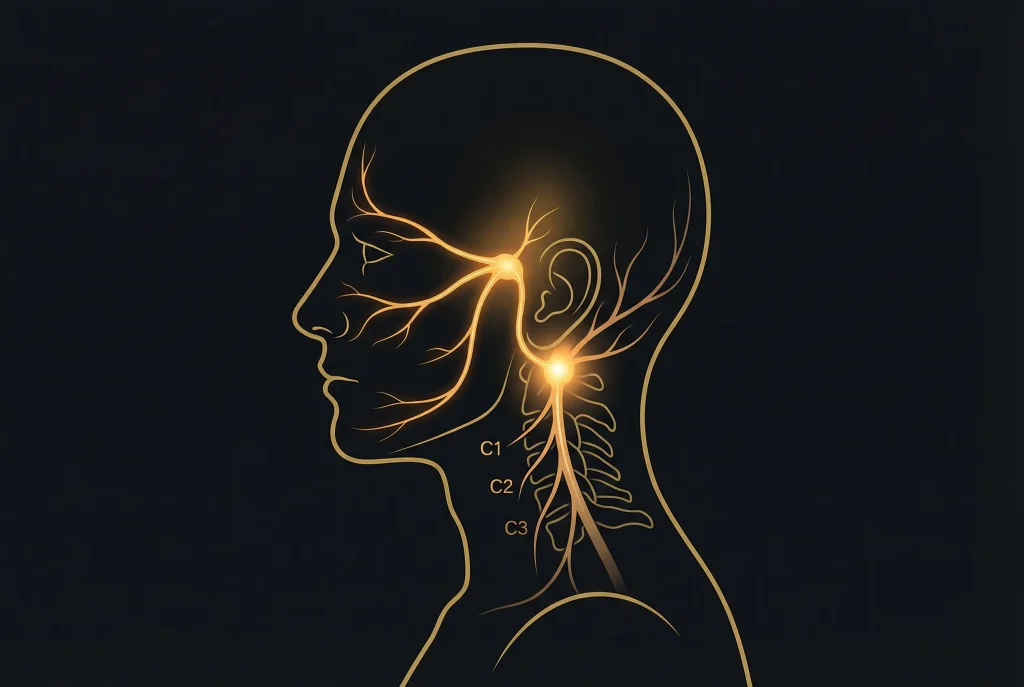
But migraines can involve the autonomic nervous system—the network involved in things like heart rate, digestion and other automatic body functions.
Research has found autonomic changes in people with migraine, including measurable differences involving heart-rate variability, although studies don’t all agree on one simple pattern.
That doesn’t mean an elevated Apple Watch heart rate diagnoses a migraine.
It absolutely doesn’t.
But in my case, looking backward through my own history made me realize something useful:
My body seemed to have a pattern.
And I had been ignoring it.
Then There Was My Stomach
This one had been miserable.
During bad attacks, nausea could become almost as disabling as the headache.
There were times when taking an oral medication felt almost pointless because I was already nauseated by the time I swallowed it.
For years, I thought that meant I had migraines and some separate stomach problem.
Then I learned something I wish somebody had explained earlier.
Migraine is associated with changes in gastric emptying.
Research has documented delayed gastric emptying in people with migraine, and that delay may affect how quickly oral migraine medications are absorbed.
Suddenly, one of my “separate” problems didn’t look quite so separate.
That didn’t mean every stomach symptom I’d ever experienced was caused by migraine.
But it finally gave me a reason why the nausea and the headache seemed to arrive together so often.
And then I started wondering about the other things.
What About My Jaw?
I had been wearing a night guard because I clenched my jaw.
Some mornings I woke up feeling as though I’d spent eight hours biting down on something.
My temples hurt.
My jaw felt tired.
Sometimes the muscles near my ears were sore.
I had always filed this under:
Dental problem.
But migraine, jaw pain and temporomandibular problems can overlap.
The trigeminal nerve—the major sensory nerve involved in migraine pain—has branches that serve different areas of the face, including the jaw.
That doesn’t mean everyone who grinds their teeth is secretly having a migraine.
And it would be wrong to say bruxism “isn’t really bruxism.”
But for someone who already has migraine, jaw and facial symptoms may be part of a much larger pain pattern.
That was exactly what my neurologist wanted me to start paying attention to.
Not just:
Where does it hurt?
But:
When does it happen?
And Then There Were My Ears
This had always been one of the weirdest symptoms.
My ears would feel plugged.
Not painfully infected.
Not like I had water trapped inside.
Just… full.
Pressure.
Sometimes I would swallow repeatedly trying to make them pop.
An ENT had examined my ears before and nothing dramatic showed up.
So I assumed this was another unrelated problem.
Then I discovered that migraine can be associated with ear symptoms too.
Reviews of migraine patients describe aural fullness, tinnitus, ear pain, dizziness and other vestibular or auditory symptoms, and researchers believe trigeminal and autonomic pathways may help explain some of that overlap.
I remember reading that and putting my phone down.
Heart.
Stomach.
Jaw.
Ear.
Head.
For years, I had organized my body according to doctors’ offices.
Cardiology over here.
Gastroenterology over there.
Dentist here.
ENT there.
Neurology somewhere else entirely.
My nervous system obviously hadn’t received the memo.
The Appointment That Changed How I Watched My Migraines
When I changed neurologists, I brought everything.
Medication list.
Old notes.
Migraine history.
Symptoms I thought probably weren’t important.
I expected another conversation about triggers and rescue medications.
Instead, she asked me to describe what happened before an attack.
That question changed everything.
Not the headache.
Not what I did once I was lying in a dark room.
Before that.
I started listing things.
The strange shift in my vision.
The neck tension.
The nausea beginning to creep in.
Sometimes the jaw tightness.
Occasionally the ear pressure.
And then I mentioned that my watch sometimes showed my heart rate climbing.
She didn’t tell me my watch was diagnosing migraines.
She told me something much more useful:
Start tracking the pattern.
Migraine prodrome can be surprisingly consistent within the same person, which is why recognizing your own early signs can give you a chance to follow your treatment plan earlier.
That became my new obsession.
I Went Back Through Months of Apple Watch Data
I compared attacks I remembered clearly with my watch history.
I wasn’t expecting perfection.
And I didn’t find it.
Sometimes my heart rate was higher because I had been walking.
Sometimes I was stressed.
Sometimes there was no obvious change at all.
But on several attacks, there it was:
A small change before I recognized the headache.
Suddenly the Apple Watch wasn’t interesting because it could “detect migraines.”
It couldn’t.
It was interesting because it forced me to look at the 20 or 30 minutes before I personally noticed certain attacks.
That was the window I had been missing.
That’s When I Became Interested in Florus
Once I started paying attention to early symptoms, my entire migraine strategy changed.
I no longer wanted to wait until I was deep into an attack before deciding whether something was happening.
During that research, I came across a topical roll-on called Florus Relief.
The company recommends applying it to areas such as the temples, neck and behind the ears at the first signs of an attack.
Its current ingredient list includes peppermint, menthol, magnesium glycinate, feverfew extract and German chamomile.
I had tried peppermint products before.
Most gave me a cold forehead and not much else.
So I wasn’t expecting a miracle.
But I liked the idea of having something I could reach for immediately when I noticed one of my early warning signs.
No waiting to decide whether the attack was “bad enough.”
Just part of my early-response routine.
The First Time I Used It, I Almost Used It Too Late
It was a Sunday.
I noticed the visual feeling first.
Not a full aura.
Just that familiar sense that something about the room looked slightly wrong.
Then came pressure near my left eye.
I checked my watch.
My heart rate was a little higher than I expected while sitting still.
That was enough for me.
I rolled Florus across my temples and along the back of my neck.
The peppermint and menthol cooling sensation came quickly.
And then I waited.
This is the part where online health stories usually say:
“Within 90 seconds everything disappeared.”
That wasn’t how I thought about it.
What mattered to me was that I had finally acted early.
I stopped working.
Drank water.
Dimmed the room.
Followed the migraine plan I had discussed with my clinician.
And used the roll-on as one part of that routine.
The attack never became one of my terrible ones.
Was that because of Florus?
Was it because I caught the attack earlier?
Would that particular migraine have remained mild anyway?
I can’t honestly prove which.
What I can tell you is that it changed what I did the next time.
I Started Treating the Beginning Instead of Waiting for the Disaster
That was the biggest shift.
For eighteen years, my migraine routine had been reactive.
Wait.
Wonder if this is actually a migraine.
Keep working.
Wait a little longer.
Realize it definitely is.
Then scramble for everything.
Now I was watching for my personal combination.
Eye pressure.
Neck or jaw tension.
Nausea.
That odd sensory shift.
Sometimes the watch pattern.
And when enough pieces lined up, I responded.
Early treatment isn’t some alternative-health idea.
The American Migraine Foundation specifically encourages people who recognize their prodrome to follow the acute treatment strategy they’ve developed with their healthcare provider as soon as possible, because earlier intervention may lessen the severity of an attack.
That gave me much more confidence in what I was doing.
Something Else Happened Over the Following Weeks
I became less afraid of every individual symptom.
That may sound small.
It wasn’t.
Before, if my heart felt faster, I worried about my heart.
If my stomach became nauseated, I worried about my stomach.
Ear pressure?
Something wrong with my ears.
Jaw soreness?
My teeth again.
Now I started asking another question first:
Is a migraine building?
Sometimes the answer was no.
And that matters.
New or unusual heart symptoms still deserve medical attention.
Persistent ear symptoms still deserve evaluation.
Significant gastrointestinal problems shouldn’t automatically be blamed on migraine.
But when the familiar cluster appeared in the familiar order, I no longer felt like four unrelated parts of my body were failing simultaneously.
I had a framework.
That alone changed how frightening attacks felt.
I Did NOT Throw Away My Prescriptions
I want to be very clear about this because I see dangerous advice online all the time.
I did not decide that a roll-on had “cured” me and stop prescribed medications on my own.
A beta blocker, migraine medication, stomach medication or any other prescription should not be abruptly stopped because somebody on Facebook had a good experience with a topical product.
Medication changes belong in a conversation with the clinician who prescribed them.
Florus became a tool in my routine.
Not a replacement for medical care.
And I think that distinction gets lost in far too many migraine stories.
So What Does Florus Actually Do?
Florus markets its roll-on as a fast topical option for people with migraines and headaches.
The cooling sensation from peppermint and menthol is easy to feel.
The company also promotes magnesium, feverfew and chamomile as part of its migraine-focused formula, and currently advertises a 90-day money-back guarantee and more than 50,000 units sold.
What I would not tell another migraine sufferer is that a topical roll-on has been proven to physically “reset” the trigeminal nerve in 90 seconds.
I haven’t seen independent clinical evidence establishing that claim for this specific product.
And I wouldn’t claim that magnesium rubbed on the temples works the same way as magnesium formulations studied in migraine prevention.
Those are much bigger scientific claims.
But do I keep the roll-on nearby?
Yes.
Because I like having something easy to use the moment I notice my early pattern.
The Biggest Discovery Wasn’t Actually the Roll-On
It was learning that migraine is bigger than head pain.
That sounds obvious now.
It wasn’t obvious to me for eighteen years.
Migraine involves complex sensory and neurological systems, and autonomic symptoms can accompany attacks. Nausea is common. Ear fullness can occur in some people. Neck and facial symptoms can overlap with migraine.
Once I understood that, my medical history stopped looking like a random collection of problems.
Not every symptom had to be caused by migraine.
But they also didn’t automatically have to be unrelated.
That was the piece I had been missing.
Now My Apple Watch Means Something Different to Me
I still wear it every day.
But I don’t stare at my heart rate thinking it can tell me whether a migraine is coming.
That’s giving a consumer watch far too much power.
Instead, I use it as one piece of information.
If my heart rate looks unusual and my neck is tightening and that familiar visual shift appears?
I pay attention.
If none of my other symptoms are there?
I don’t assume anything.
Over time I’ve learned that my earliest warning system isn’t the Apple Watch.
It’s me.
The watch just helped me notice the pattern.
If You Have Migraines Plus “Other Weird Problems,” Start Writing Things Down
Not just the headache.
Write down what happened in the hours before it.
What did your stomach feel like?
Was your neck tight?
Did your ears feel strange?
Were you unusually tired?
Did you yawn constantly?
Did you suddenly crave something?
Was your concentration off?
Did your heart feel different?
Don’t use that list to diagnose yourself.
Use it to have a much better conversation with your neurologist.
Because you may discover that symptoms you’ve been mentally storing in completely different boxes tend to arrive together.
That realization changed eighteen years of migraine management for me.
Eighteen Years Later, I Finally Watch the Beginning
I used to measure my migraines by how bad the headache became.
Now I pay much more attention to how they start.
That’s where my Apple Watch story really comes from.
It wasn’t secretly diagnosing migraines for years.
It was recording one tiny piece of what my body was already doing.
I just didn’t know to look.
And when I finally started looking at the entire pattern—the nausea, the neck and jaw tension, the sensory changes, the occasional ear pressure and the changes I noticed on my watch—I stopped feeling like my body was throwing random problems at me.
I started seeing a sequence.
Florus is now one of the things I keep nearby for that early window.
Not because I believe one little roll-on magically fixes an eighteen-year neurological condition.
But because when I recognize my familiar warning signs, I want my routine ready before I’m lying in a dark room wishing I’d acted sooner.
If you’ve lived with migraines for years, maybe that’s the question worth asking yourself tonight:
What happens before your head starts hurting?
Because your earliest warning may be something you’ve been experiencing for years.
You just never realized it belonged to the migraine.
This article reflects a first-person experience and is for general informational purposes. Migraine symptoms can overlap with other medical conditions. New, severe or unusual symptoms—including significant heart-rate changes, neurological symptoms or hearing changes—should be evaluated by a qualified healthcare professional. Do not stop prescribed medications without discussing the change with your clinician.